
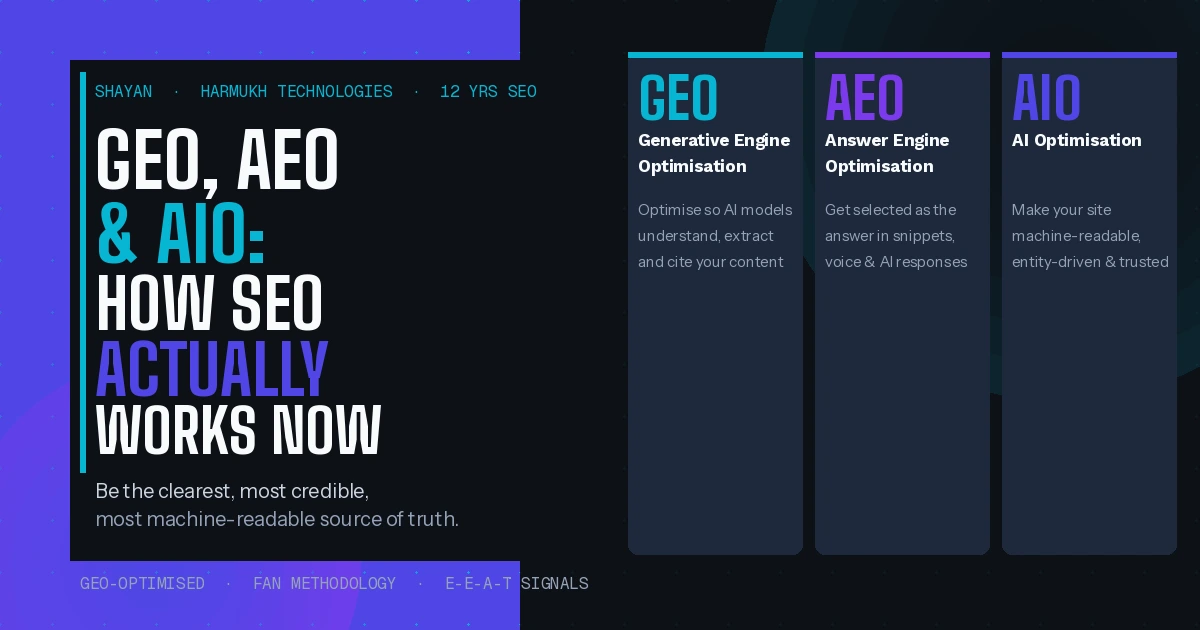
About this guide: Written by Shayan, founder of Harmukh Technologies — 12 years in SEO, spanning every major algorithm era from keyword density to entity-based ranking to the current AI transition. The playbook in this article is what we apply to live client campaigns right now, not what we theorise about.
Published: March 2026 · Reading time: 13 minutes
The SEO industry has produced a new wave of acronyms: GEO, AEO, AIO, LLMO. Each arrives with its own specialists, its own pricing tier, and its own deck full of jargon. After 12 years watching this pattern repeat, I want to give you the honest version before we get into tactics.
These aren’t new disciplines. They’re SEO evolving to match how AI systems read, understand, and cite information. The underlying logic — be the clearest, most credible, most machine-readable source of truth on your topic — has been the core of excellent SEO since Google shifted from keyword matching to semantic understanding. What has changed is where that content needs to perform, and what “machine-readable” means when the machines are large language models rather than crawl bots.
If you understand how search engines think, you’ll always stay ahead — no matter how fast algorithms change.
Today, Google, ChatGPT, Perplexity, Gemini, and Claude behave more like answer machines than search engines. They don’t return lists of documents — they synthesise responses. The content that earns a place in those responses is not the content optimised for keyword density. It’s the content that can be extracted, trusted, and cited.
This guide breaks down what GEO, AEO, and AIO actually mean — and gives you the exact 9-step playbook we use at Harmukh Technologies to build the kind of presence that answer machines select.
What This Guide Covers
 What Is GEO (Generative Engine Optimisation)?
GEO is the process of structuring your content so that AI language models can understand it, extract from it, and cite it inside generated answers. When ChatGPT, Perplexity, or Google AI Overviews synthesise a response to a query, they are selecting source material from indexed content. GEO is the discipline of making your content the material they select.
What AI engines actually scan for — and what they ignore
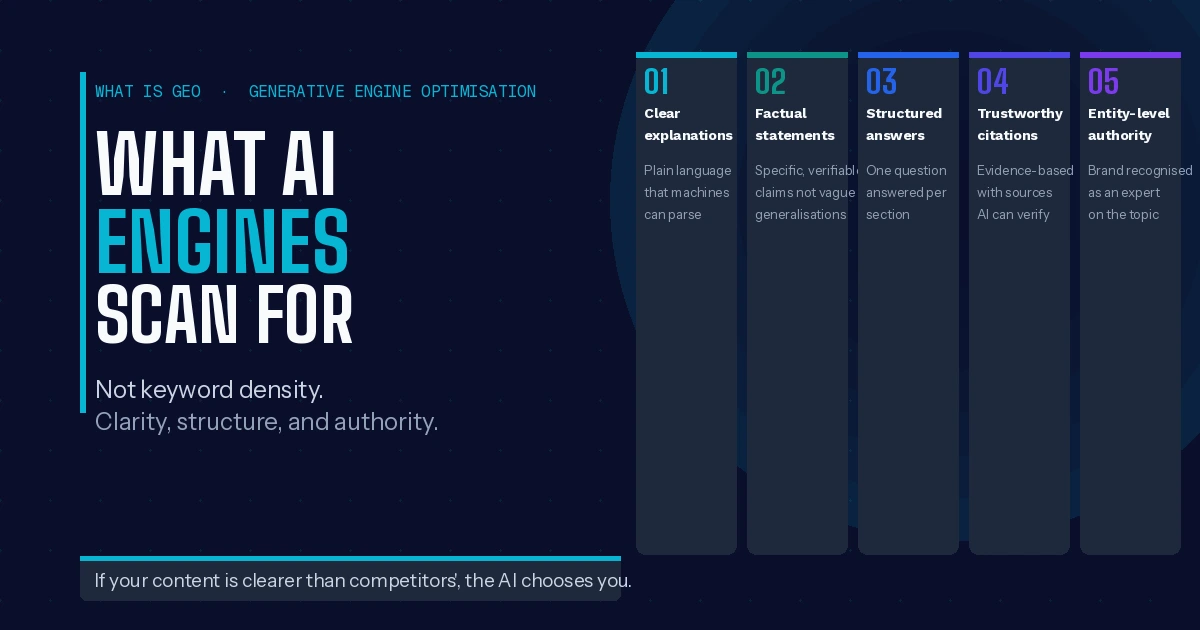
AI systems evaluating content for citation are not measuring keyword density, checking word count against a recommended range, or counting how many times the target phrase appears in H2 tags. These are signals built for a different era of search. What modern AI retrieval systems evaluate is fundamentally different:
Clarity of explanation. Can the content’s key claims be understood and extracted without additional context? AI systems prefer content with clean, self-contained sentences that communicate a complete idea. Long, qualification-heavy paragraphs that require the surrounding context to be interpretable are harder to cite cleanly. Short, factual, direct sentences are significantly more citable.
Factual specificity. Vague generalisations — “many businesses find that SEO improves results” — provide AI systems with nothing verifiable to cite. Specific, attributable claims — “60–70% of Google searches end with zero clicks, according to industry analysis” — are precisely the kind of statements AI systems use as citation anchors. The more specific and verifiable your claims, the more useful they are as source material.
Structural answerability. Each section of your content should answer one well-defined question completely. AI systems retrieving information for a specific query need to find a section of content that addresses that query directly and completely — not infer an answer from across multiple scattered sections. Content structured as explicit Q&A nodes (each H2 is a complete question, each section is a complete answer) is significantly more citable than content structured as a continuous narrative.
Source credibility signals. AI systems are trained on content that distinguishes between authoritative and non-authoritative sources. Entity authority (is this brand recognised as a credible source on this topic?), citation of primary sources, author attribution with demonstrable credentials, and schema markup that explicitly declares the content’s nature and authorship all contribute to the credibility signals AI systems use in citation selection.
What Is AEO (Answer Engine Optimisation)?
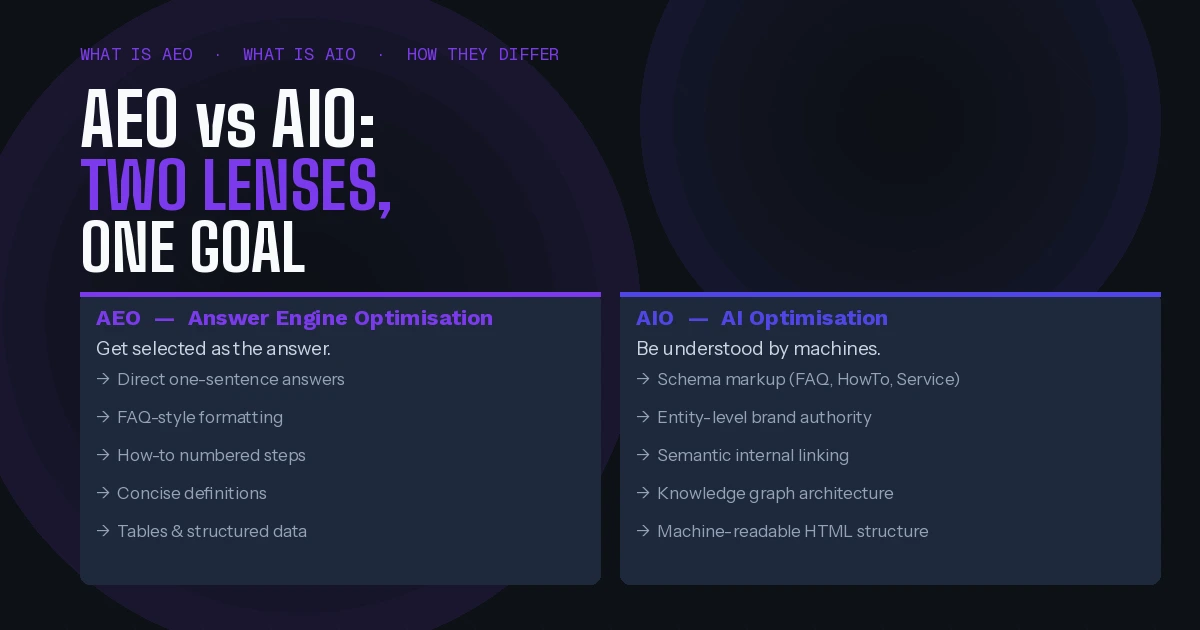
AEO is the discipline of engineering your content to be selected as the direct answer to a specific query — whether in Google’s featured snippets, voice search responses, People Also Ask results, or AI-generated answer boxes. Where GEO optimises for citation within a synthesised response, AEO optimises for selection as the definitive answer to a discrete question.
What AEO specifically targets
AEO is, at its core, precision-engineered classic SEO. The signals that produce featured snippet and answer box selection are well-documented: a direct one-sentence answer at or near the top of the relevant section, FAQ-style formatting that makes the question-answer relationship explicit, how-to numbered steps for process queries, concise definitions for concept queries, and tables for comparison queries.
The content format matters because Google’s featured snippet algorithms and AI answer selection systems both share a common need: they need to extract a discrete, complete answer to a specific question without extensive reformatting. Content structured to make that extraction easy — with the answer immediately following the question, formatted cleanly, and sized appropriately for the query type — wins disproportionate answer box placement relative to its organic ranking position. It is not uncommon for a page ranking in position 4 or 5 to hold the featured snippet for a query because its answer formatting is cleaner than the pages ranked above it.
What Is AIO (AI Optimisation)?
AIO is everything you do to make your website machine-readable, semantically rich, and entity-driven — so that AI systems understand who you are, what you do, and why you’re credible. If GEO is about making individual content pieces citable and AEO is about making specific answers extractable, AIO is about building the underlying architecture that makes the whole domain trustworthy to AI systems.
This is where schema markup, internal linking architecture, and content structure become essential — not as technical checklists but as the infrastructure through which AI systems form a model of your brand’s identity and expertise. AIO asks: does an AI system that encounters your brand across multiple contexts — your homepage, your service pages, your blog, your schema markup, your external mentions — develop a consistent, accurate, and credible picture of what your brand is authoritative on?
As we examine in detail in our guide to what actually works in SEO in 2026, GEO, AEO, and AIO are not three separate methodologies — they are three lenses on the same underlying goal: being the clearest, most credible, most machine-readable source of truth for your topic area.
The 9-Step Playbook: How to Actually Do GEO, AEO & AIO
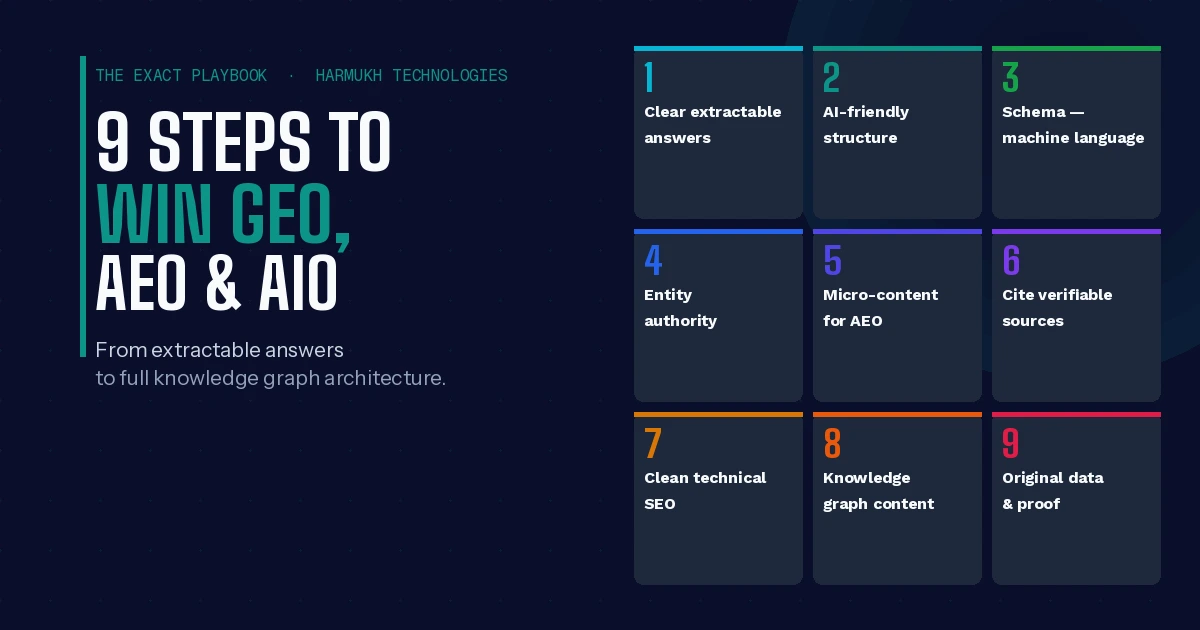
Here is the exact framework we apply at Harmukh Technologies. Each step maps to a specific mechanism by which it improves AI citation probability, answer selection frequency, or entity authority — not just a best-practice checklist.
Step 1: Start with Clear, Extractable Answers
Every major page should open with a direct, self-contained answer to the primary question the page addresses. Not a preamble, not a context-setting introduction — an actual answer, ideally in one or two sentences, that an AI system could extract and cite without modification.
The structural pattern: TL;DR box at the top of the page, a definition sentence for the primary concept, and a direct answer to the main query before any elaboration. This is not just good writing practice — it is the content pattern that featured snippet algorithms, voice search systems, and AI answer generators are specifically designed to identify and extract. Our complete on-page SEO guide covers the exact formatting specifications for different query types.
Example of a citable, extractable sentence:
GEO (Generative Engine Optimisation) is the process of structuring content so that AI language models can understand, extract, and cite it within generated answers — distinct from traditional keyword optimisation, which targets crawler relevance signals rather than LLM citation selection.
Short. Specific. Defines the entity (GEO), names the mechanism (structuring for extraction), and distinguishes it from adjacent concepts (keyword optimisation). Citable by any AI system encountering a query about GEO.
Step 2: Use AI-Friendly Content Structure
AI systems struggle with long, dense paragraphs that embed multiple ideas without clear structure. The content structure that maximises AI retrievability is the same structure that maximises human readability for high-intent queries: H2 questions that explicitly state what the section answers, bullet lists for sets of items, numbered steps for processes, mini-tables for comparisons, and clearly labelled glossary entries for key terms.
The principle is: every section should answer exactly one question extremely well. A section that partially addresses four questions is not citable for any of them. A section that comprehensively addresses one question is a highly citable node. This is the core of the FAN (Fan-Out, Authority-Signal, Node Architecture) content methodology we apply across all client work — each H2 is a discrete, independently answerable and indexable node. The SEO trends defining 2026 section on Search Everywhere Optimisation expands on why node architecture matters specifically for AI retrieval systems.
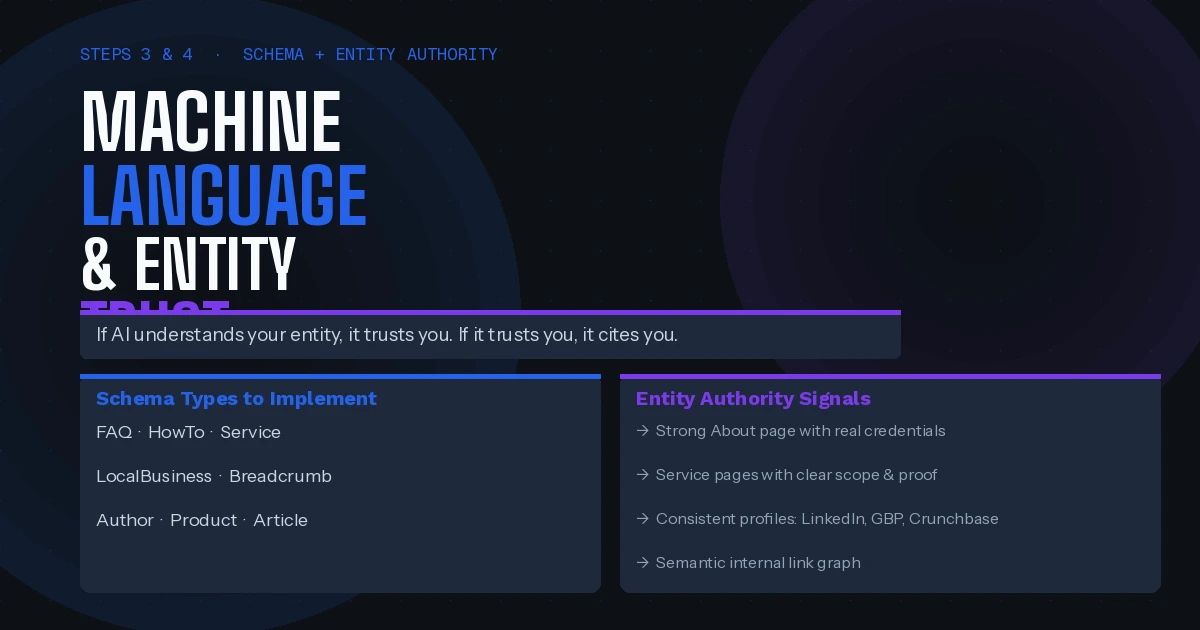
Step 3: Implement Schema — Your Machine Language
If SEO has a highest-leverage technical implementation, schema markup is it. Schema is the explicit machine-readable layer that tells AI systems and crawlers not just what your content says, but what type of content it is, who wrote it, what entities it discusses, and how credible those entities are.
The schema types with the highest current impact for GEO and AEO performance: FAQ schema for Q&A content (directly feeds into featured snippets and People Also Ask); HowTo schema for process content (directly feeds into step-by-step AI answer formatting); Article schema with Author entity (establishes E-E-A-T attribution at the machine level); Organization schema on all pages (builds entity consistency across the domain); LocalBusiness schema for any local service area content; BreadcrumbList schema for hierarchy signals.
When you implement schema, you are not just optimising for a technical checklist — you are feeding structured knowledge to AI systems about what your content is, who produced it, and why it should be trusted. You’re writing in their native language. Our 90-day SEO plan includes the full schema implementation sequence, prioritised by impact.
Step 4: Build Entity Authority — E-E-A-T for the AI Age
Google and AI models don’t rank keywords — they rank entities. A keyword is a string of text. An entity is a recognisable, classifiable thing with a known identity and a set of known relationships to other things. Your brand is an entity. Your authors are entities. Your service areas are entities. The degree to which AI systems can accurately identify and classify your brand entity — and assess its authority on the topics it claims to cover — directly determines citation probability.
Building entity authority in practice: a comprehensive About page with real, verifiable credentials and expertise signals; service pages that establish clear scope and include proof (case studies, client outcomes, methodology documentation); consistent brand profiles across LinkedIn, Google Business Profile, Crunchbase, and industry directories — because entity consistency across multiple independent platforms strengthens AI systems’ confidence in the entity’s identity; and internal linking architecture that forms a coherent semantic graph, making the relationships between your brand entity and its topic areas explicit and navigable. As we document in our analysis of how backlinks and authority signals work, external recognition from relevant third-party sources is still the most powerful entity authority signal available.
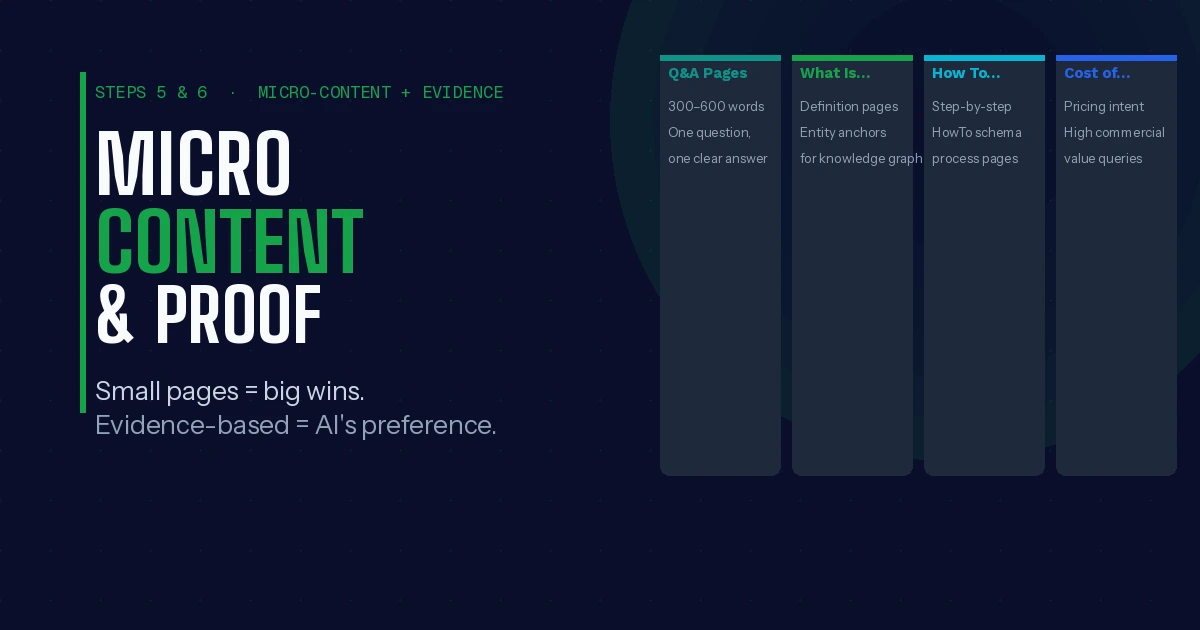
Step 5: Publish Micro-Content for AEO — Small Pages, Big Wins
The content format that produces the highest return for AEO is not the comprehensive 4,000-word pillar page — it is the focused, 300–600-word micro-page that answers a single specific question completely. These pages are purpose-built for answer selection: their entire content budget is directed at one query, which means they can answer it with a depth and specificity that a pillar page covering twelve related topics cannot match.
The micro-content formats that dominate answer selection: “What is [X]?” definition pages for entity and concept queries; “How to [do X]” step-by-step pages with HowTo schema for process queries; “Cost of [X]” or “[X] pricing” pages for commercial intent queries with high purchase urgency; “[X] vs [Y]” comparison pages for evaluation-stage queries; FAQ pages for clusters of related short-form questions. Each of these formats maps directly to a query type that Google’s featured snippets, People Also Ask, voice search, and AI answer boxes are designed to serve. As we explore in our guide on why you should stop churning out blog posts, publishing fewer, more targeted pieces consistently outperforms high-volume, low-focus content production.
Step 6: Cite Sources — AI Prefers Evidence-Based Content
AI models are trained on a corpus that includes peer-reviewed research, authoritative journalism, government sources, and academic publications. This training creates a measurable preference: content that cites verifiable sources for specific claims is evaluated as more credible than content making the same claims without attribution. This is not just a GEO principle — it is a direct reflection of how E-E-A-T (Experience, Expertise, Authoritativeness, Trustworthiness) functions as a ranking signal.
Practical application: any time your content mentions a statistic, industry data point, regulation, pricing range, or empirical finding, cite the source. Link to primary sources wherever possible — government data, industry research bodies, original studies. Where you are citing your own research or client data, make the methodology and basis explicit. The combination of a specific claim and a verifiable source is the most citable content unit available — it gives AI systems both the statement to extract and the attribution to verify.
Step 7: Keep Technical SEO Clean
In the AI era, technical SEO is not less important — it is the prerequisite that makes everything else possible. AI systems that index and retrieve from the web use the same crawling and indexing infrastructure as traditional search. Pages with JavaScript-blocked content, slow load times, broken canonical configurations, or invalid schema are less reliably crawled and indexed, which means they are less reliably available as source material for AI synthesis. AI reads your raw HTML, not your rendered UI.
The technical baseline that matters: page speed within Core Web Vitals thresholds, clean HTML with valid heading hierarchy (one H1, logical H2-H3 nesting), canonical URLs correctly implemented, no JavaScript-blocked primary content, valid schema with no structured data errors, and crawl budget managed through clean internal link architecture. As we detail in our SEO audit blind spot guide, technical issues are the most commonly overlooked suppressors of content performance — including AI citation performance.
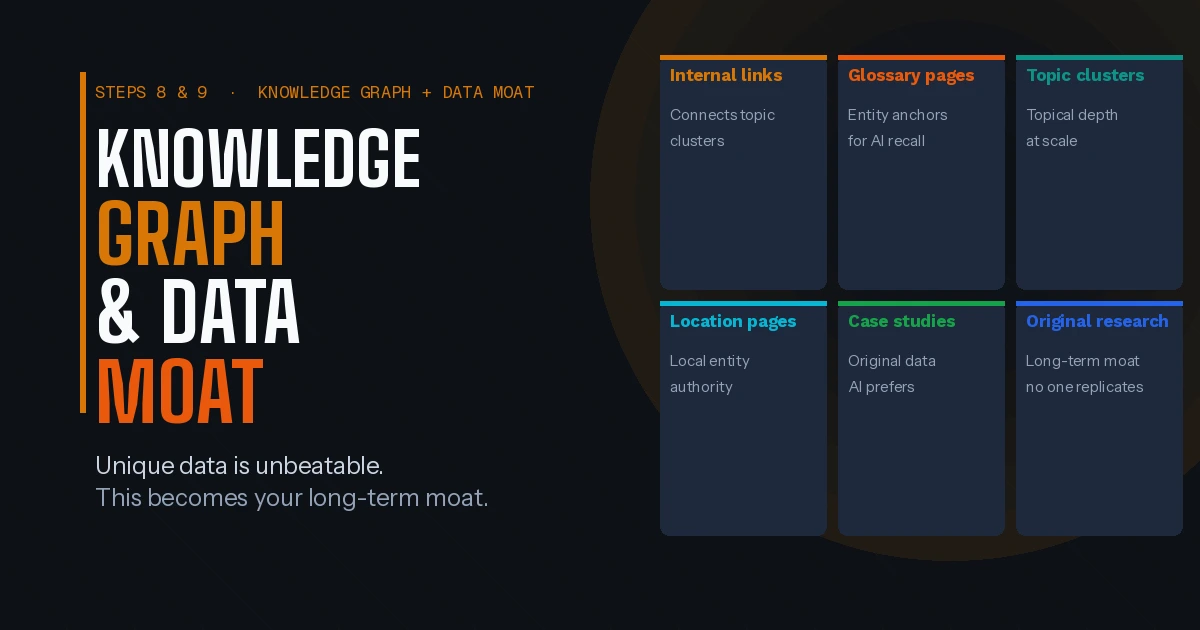
Step 8: Build Your Brand’s Knowledge Graph
AI systems construct a semantic model of every brand they encounter across indexed content. This model — effectively a knowledge graph of who you are, what you cover, and how your topics relate to each other — is what determines whether an AI system recognises your brand as an authoritative source for a specific query type. You build this model deliberately through the content architecture you create.
The content types that feed the knowledge graph most effectively: internal links that create explicit navigational paths between related topic areas (showing AI systems the relationship between concepts, not just listing them separately); glossary pages that define the key terms in your domain (establishing your brand as the definitional authority on your vocabulary); topic cluster architecture where pillar pages link to and from supporting micro-pages (demonstrating comprehensive coverage of a subject area); canonical service pages that establish the precise scope and nature of your offerings; and location pages for local businesses that create geographic entity associations.
The outcome of a well-developed knowledge graph is compound discovery: AI systems begin surfacing your content for queries you didn’t explicitly target, because your brand’s entity map is dense enough in a topic area that it matches the semantic field of a wide range of related queries. This is the mechanism behind the observation that strong topical authority produces rankings across hundreds of related keywords — not just the ones you directly targeted.
Step 9: Publish Original Data — Your Long-Term Competitive Moat
In an environment where AI can generate adequate generic content at near-zero marginal cost, the scarcest and most valuable content type is data that no one else has. Original research, client case studies with specific outcome data, industry benchmarks you’ve generated from your own client base, pricing breakdowns based on actual market experience — these are the content assets that AI systems cannot replicate from synthesis, because they don’t exist anywhere else in the training corpus.
Original data creates citation gravity: once a piece of data becomes a widely-referenced statistic in your industry, it generates backlinks, citations, and mentions that compound over time. AI systems encountering your data point across multiple independent sources — because others have cited it — progressively strengthen their confidence in your brand as an authoritative source for the topic it covers. As we document in our guide to the future of SEO trends in 2026, UGC and first-party data are among the top-cited content types across all major AI retrieval systems — for exactly this reason.
So Is GEO a Thing? AEO? AIO? The Honest Answer.
Yes — but not as separate disciplines with separate methodologies and separate specialist price points. They are three lenses on the same underlying reality: SEO in the AI era is about being the clearest, most credible, most machine-readable source of truth for your topic area.
A brand that achieves this will be quoted, cited, recommended, ranked, and driven traffic to — across traditional organic search, featured snippets, AI Overviews, ChatGPT, Perplexity, and every other discovery surface that emerges in the next few years. A brand that optimises keywords without the underlying substance will disappear from those surfaces even if it temporarily holds rankings through technical manipulation — because AI systems are specifically better at evaluating substance than keyword-matching algorithms were.
As we make clear in our analysis of why GEO as a standalone acronym doesn’t hold up and in our examination of the truth behind AIO, GIO, and other SEO buzzwords, the premium pricing for “GEO specialists” and “AEO consultants” is almost always attached to work that any competent SEO practitioner has been doing for years under different names. What matters is not which acronym your agency uses — it’s whether the underlying work builds genuine entity authority and creates content that answer machines select.
✔ Quote you ✔ Cite you ✔ Recommend you ✔ Rank you ✔ Drive traffic to youIf you optimise keywords without the underlying substance, you’ll be outcompeted by brands that AI systems recognise as more credible — even if they rank lower in traditional organic results.
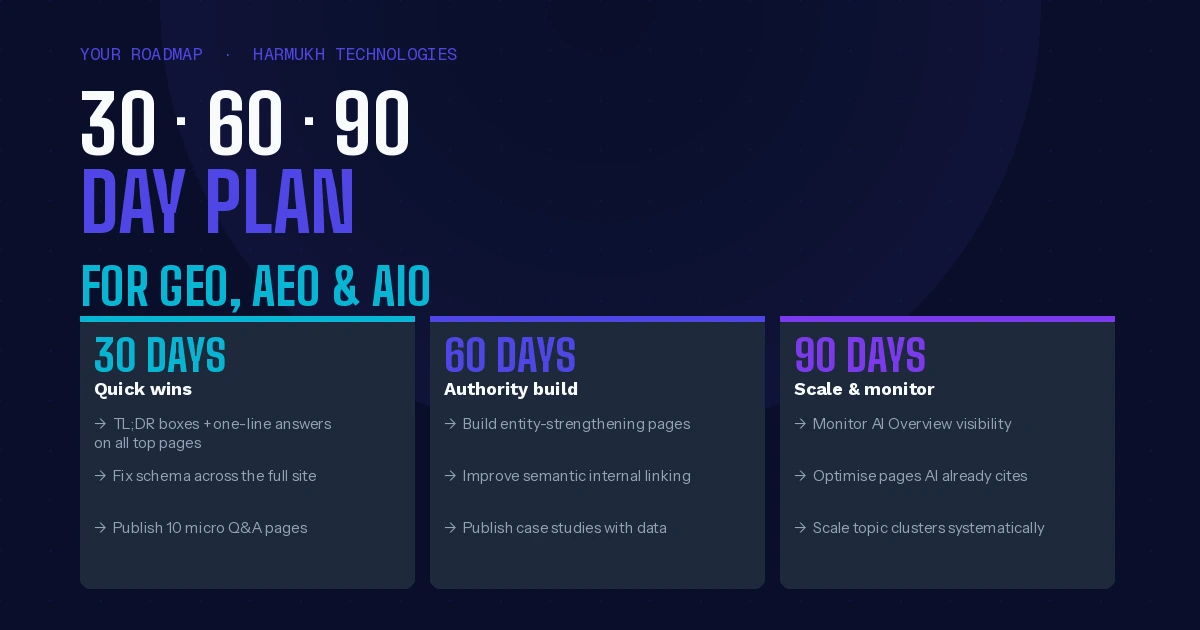
The 30/60/90-Day Implementation Roadmap
Here is the prioritised sequence we use with clients implementing GEO, AEO, and AIO from the ground up. The sequencing reflects impact order: quick wins that immediately improve AI citation probability in the first 30 days, authority-building work in the 31–60 day window, and scale and monitoring in the 61–90 day phase.
Days 1–30: Quick Wins
Add TL;DR boxes and direct one-line answers to the top of all high-traffic pages. This single change makes existing content immediately more citable by AI systems — you are not writing new content, you are restructuring the entry point of content you already have. Audit and fix schema markup across the site: correct invalid structured data, add missing FAQ schema to Q&A sections, implement Article schema with Author entity on all blog posts. Publish ten focused micro Q&A pages targeting specific high-intent queries in your category — 300–600 words each, one question per page, direct answer at the top, HowTo or FAQ schema as appropriate.
Days 31–60: Authority Build
Build entity-strengthening pages: a comprehensive About page with detailed credentials, team pages with individual expertise attribution, case study pages with specific data and outcomes. Audit internal linking and rebuild it to form a coherent semantic graph — every important page should be reachable within 2–3 clicks from any other page in the same topic cluster, with anchor text that explicitly signals the topic relationship. Publish case studies with original data from your client work. Even simple data — “our average client sees X% improvement in Y metric within Z months” — creates unique, citable content that no competitor can replicate.
Days 61–90: Scale and Monitor
Begin monitoring AI Overview visibility through Google Search Console’s performance data and manual spot-checks for your target queries. Identify which of your existing pages are already being cited or pulled into AI answers — these pages have the strongest existing authority signals and are the best candidates for further optimisation. Develop topic cluster architecture at scale: for each of your core service or content areas, map the full query landscape and build the micro-page coverage needed to establish comprehensive topical authority. SEO isn’t dying — it’s levelling up. The brands that adapt to this new standard of credibility early will compound their advantage across every discovery surface that exists and those yet to be built.
Frequently Asked Questions: GEO, AEO & AIO
What is the difference between GEO, AEO, and AIO?
GEO (Generative Engine Optimisation) focuses on making individual content pieces citable by AI language models — structuring content so it can be extracted and used in generated answers. AEO (Answer Engine Optimisation) focuses on getting specific content selected as the direct answer to a discrete query — targeting featured snippets, People Also Ask, voice search, and AI answer boxes. AIO (AI Optimisation) is the broader domain-level work of making your entire site machine-readable, entity-driven, and semantically coherent, so AI systems form an accurate and credible model of your brand’s authority. They are three aspects of the same goal: being the most trustworthy, most extractable source of truth on your topic.
Is GEO different from traditional SEO?
GEO is not a separate discipline from SEO — it is SEO evaluated by a more sophisticated reader. The content characteristics AI systems use to select citation sources (clear entity authority, specific verifiable claims, structured Q&A format, schema attribution, evidence-based writing) are the same characteristics that have produced strong organic rankings since Google shifted to semantic understanding in 2013. What GEO specifically adds is awareness that the primary extractability of content — can an AI system pull a complete, self-contained answer from this section? — is now a direct ranking factor across multiple discovery surfaces simultaneously.
What schema types matter most for GEO and AEO?
For AEO: FAQ schema and HowTo schema are the highest-priority implementations, as they directly feed into Google’s featured snippet and People Also Ask selection algorithms. For GEO and general entity authority: Article schema with Author entity (for E-E-A-T attribution), Organization schema on all pages (for entity consistency), and LocalBusiness schema (for local discovery). BreadcrumbList schema provides hierarchy signals that help AI systems understand content organisation. Invalid schema — schema that is present but contains errors — is worse than no schema, as it can be interpreted as a credibility signal against the page.
How long does it take for GEO and AEO work to produce results?
Adding TL;DR boxes and direct answers to existing content: 2–4 weeks for the changes to be recrawled and reflected in featured snippet selection. Schema implementation: 2–4 weeks for Google to process and begin using structured data in SERP features. Micro-page publication for specific AEO targets: 4–8 weeks for new pages to achieve indexed status and begin appearing in featured snippets for their target queries. Entity authority building through case studies, About page improvements, and external profile consistency: 2–4 months for AI systems to accumulate sufficient signals to reliably classify your brand. These timelines are consistent with our client campaign data and industry case study evidence.
Do I need to hire a GEO specialist or AEO consultant?
The work involved in GEO, AEO, and AIO — schema implementation, entity authority building, content structuring for extractability, technical SEO — is standard advanced SEO practice. Any competent SEO practitioner or agency with a solid technical and content strategy background can implement it. The premium pricing attached to “GEO specialist” or “AEO consultant” labels is almost always for work that falls within standard SEO scope. What matters is whether the practitioner or agency actually understands and applies the underlying principles — not which acronym they use to describe their service. Our guide to what to look for when hiring an SEO consultant provides a practical evaluation framework.
What is the most important first step for a business new to GEO and AEO?
Add a direct, one-sentence answer to the primary question at the top of every major page, and implement FAQ schema on any page with Q&A content. These two changes are low-effort, high-impact, and immediately improve AI citation probability for existing content without requiring new content production. They also provide immediate baseline data: after 4–6 weeks, check which pages have gained featured snippet appearances or AI Overview citations — these are your highest-authority pages and the best candidates for deeper GEO and AEO optimisation.
SEO Isn’t Dying. It’s Levelling Up.
The brands losing organic visibility in 2026 are not losing because AI killed SEO. They are losing because they are still optimising for a version of search that has been superseded — one where keyword frequency, word count benchmarks, and link volume were the primary levers. Those levers still exist, but they no longer determine the outcome at the margin. What determines the outcome is whether AI systems — which now intermediate an enormous and growing share of discovery — identify your brand as a credible, extractable, citable source of truth.
That’s a higher standard than keyword optimisation. It requires genuine expertise, clearly attributed. Real data, specifically cited. Content structured for extraction, not just for reading. Schema that makes your brand’s identity and authority legible to machines. It requires, in short, the kind of SEO that was always the right approach — it just didn’t have as much competitive consequence until AI systems started doing the evaluation.
The brands that adapt early will dominate the next decade across organic search, AI citations, voice, and every discovery surface that hasn’t been invented yet. The window for compounding advantage is open now.
Ready to implement GEO, AEO & AIO for your business?
At Harmukh Technologies, this isn’t theory — it’s the live playbook we apply to client campaigns right now. We’ll audit what you have, identify the highest-impact gaps, and build the content architecture and schema implementation that makes AI systems select your brand as their source.
Explore our SEO consulting services · Get in touch · Email: [email protected]
[…] are identical: authoritative, well-structured, trustworthy content. Our detailed breakdown of GEO, AEO, and AIO in the AI era shows how each term maps to existing SEO practice. SGE (Search Generative Experience) was […]
[…] external references. In other words: good SEO. As we document in our detailed analysis of how GEO, AEO and AIO actually work in the AI era, the tactical difference between “optimising for AI citations” and “doing […]
[…] detailed breakdown of how GEO, AEO, and E-E-A-T interact in AI search covers how these same signals translate into AI citation eligibility — the YMYL framework Google […]
[…] broader guide to how GEO and AEO work in AI search covers the underlying citation mechanics that apply across all legal content […]